

THE CUSTOMER BEHIND YOUR CUSTOMER
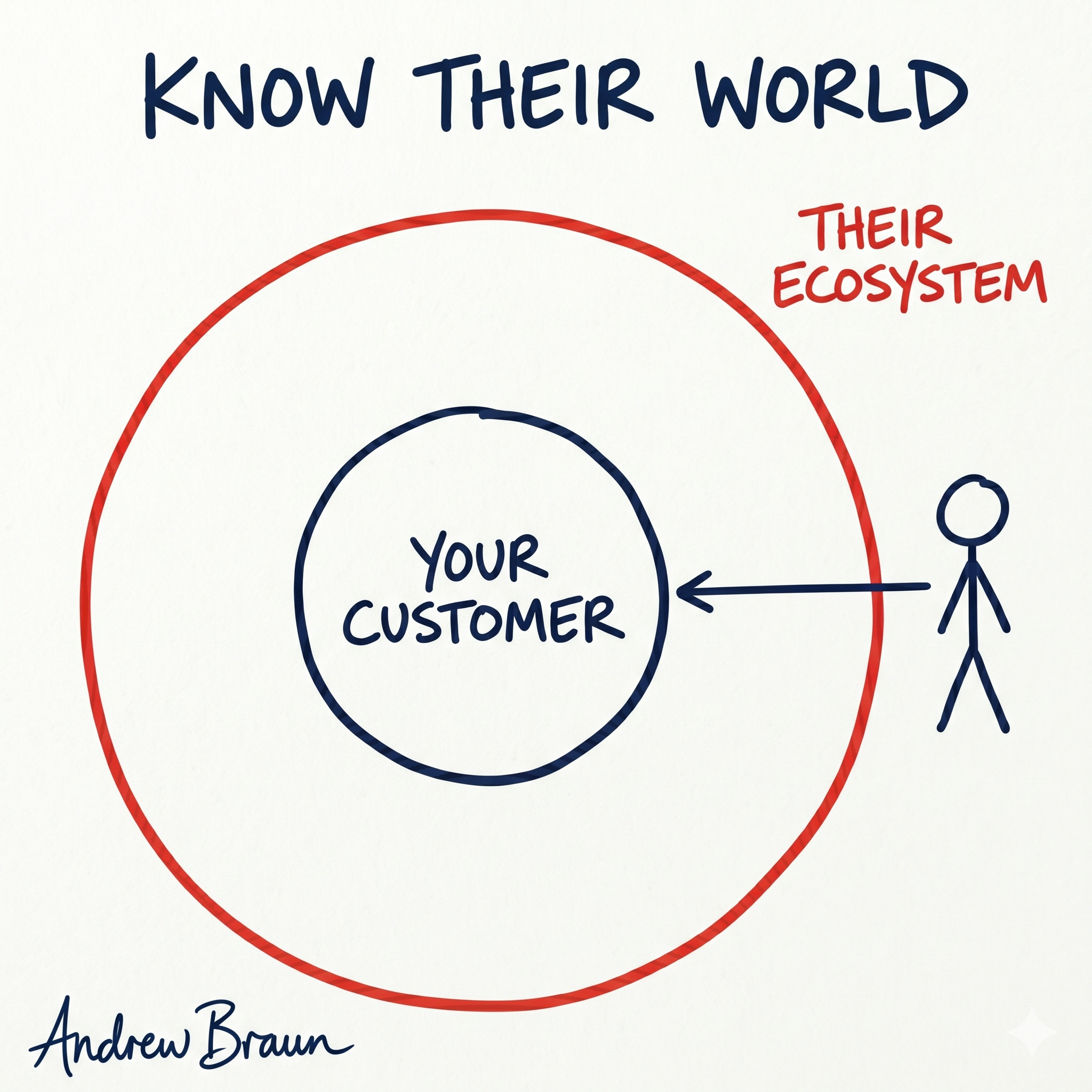
In B2B, the businesses that become indispensable don't just research who buys from them. They research who their customers serve.

The Signal by Andrew Braun. One business framework per week, for people looking to better understand the intersection of business, customers and technology.
A recruiter at a specialist staffing firm spent most of her time justifying to her client time-to-fill rates, candidate quality scores, and fee structures. These were the metrics the HR teams she billed tracked, so she tracked them too.
Then she read a piece of research which asked the department heads who ran the actual job interviews, what they valued most from a recruitment agency relationship. Surprisingly the top answer had nothing to do with speed or volume, but it was being told early when a job brief was unrealistic.
The finding didn’t come from her own client conversations: her book was too small and too familiar for that kind of visibility, but came from research that could ask the question at scale, across the whole industry.
What needs to change
Most B2B companies research their direct customers thoroughly. NPS surveys, buying journey mapping, renewal signals, win/loss interviews: done well, this work builds a clear picture of how your customers experience your product and your relationship with them. What they need from you, what frustrates them, what they’d like you to build next.
That picture is accurate and worth having, but it doesn’t capture the world your customers are operating in: who they’re trying to serve, what their own market is asking of them, their supplier relationships.
The shift from vendor to strategic partner usually comes down to one thing: knowing something about the customer’s world that the customer may not know, or at least that you should know.
“The research that changes your competitive position tells you something about the customer’s world that the customer can’t easily generate on their own. That intelligence shifts the nature of the relationship: from a vendor your customer buys from, to a source of market knowledge they can’t afford to lose access to.”
What it looks like in practice
At Netwealth, our direct customers were financial advisers. We understood their product requirements, investment needs, compliance context, and their technology preferences thoroughly.
But from 2017, we started surveying the people advisers served: 1,000+ Australian investors annually, segmented by age and wealth into four distinct groups. The findings were things advisers couldn’t easily generate themselves. Things they felt, but couldn’t factually prove. Data on what wealthy Australians wanted from the advice relationship, what the next generation of investors expected from wealth technology, and so on. Intelligence advisers could use in their own client conversations and when developing their service and value propositions.
What the research produced wasn’t only a content marketing asset for Netwealth, or a brand building campaign, but it changed how we described what we built. The client portal, previously positioned around helping advisers stay in touch with clients, was reframed as a tool where clients could stay informed and get peace of mind. Managed accounts, typically sold as a way to scale a practice, became a way to deliver consistent investment outcomes for every client.
Our messaging was not only influenced, but also what we built. Recognising that investors used mobile, not just desktop, for research and portfolio activity, we redirected portfolio information toward mobile-first features.
Those decisions came from understanding the people advisers were trying to serve, not from adviser feedback alone.
“Most B2B research points at one relationship: you and your customer. That’s the right starting point, and the picture it produces is worth having, but it has a ceiling: it can only surface what your customer already knows about themselves and their own needs.”
Other examples include:
Shopify’s direct customers are merchants. But each year Shopify publishes detailed consumer behaviour data for those merchants to use. Shopify reported on the 76 million consumers who bought from Shopify-powered brands over the weekend: peak purchase timing, top product categories, average cart size, crossborder order rates. That intelligence is for merchants, not for Shopify. It exists to help Shopify’s customers understand what their own customers are doing and when.
Salesforce does something similar at a different level. Its customers are the B2B companies using its CRM, and each year Salesforce surveys those companies’ own customers, consumers and business buyers, to track how expectations and purchasing behaviour are shifting. The most recent edition covered more than 16,000 consumers worldwide on their use of AI. The findings help Salesforce’s customers understand what the people they sell to actually want from a business relationship. That intelligence shapes how Salesforce’s customers think about their market, not just how they use the software.
If you apply one thing from this 🛠️
Map your customer’s full value chain. Who do they buy from? Who do they sell to? Who influences their decisions, and who are they trying to serve?
Research downstream first: commission research on your customer’s customers, the people your customer is trying to win or retain.
Research upstream: survey or interview your customer’s suppliers and partners, the community your customer buys from.
Research adjacent: identify who else shapes your customer’s strategic decisions beyond direct buyers and sellers.
Share insights back in usable form: not just a white paper to file away, but intelligence your customer can take directly into their own commercial conversations.
Name the marketing positioning explicitly: move from “we understand our product” to “here’s what your clients told us they value from you.”
Use it in sales: “Based on research into what your clients actually want, here are three things (we offer) most likely to affect their loyalty to you.”
Use it in product development: Spot the end-customer insights that you can build to can surprise and delight your actual customer base.
My gift to you.
THE 10 CONVERSATIONS GUIDE
A starter kit for researching your customers’ clients.
The fair objection = lack of resources
The fair objection is that this requires resources most B2B companies don’t have. A 1,000-person annual survey, fielded independently with segmentation methodology and year-on-year tracking, is a serious investment. Not every B2B company has existing relationships with enough of its customers’ customers to make that survey feasible, and not every market has an obvious reason for end consumers to participate.
All of that is fair, but the scale of the Netwealth programme followed the principle over time rather than defining it. The starting point can be ten structured conversations with your customer’s clients, conducted with their permission. One question added to your next customer review: “What are your clients telling you they need from you right now?” Over months, this accumulates into a picture of the downstream world that most competitors have never looked at. If the principle has commercial value, the investment grows with the evidence.
Vendors know their product. Strategic partners know the market their customers are trying to win.
Soundtrak by Andrew Braun works at the intersection of business, customers, and technology - where strategy actually lives. For CEOs, CMOs, and founders building something that compounds. We find the signal. We build the soundtrack.